

Most families who start looking at schools in South Mumbai describe the process in similar ways after they’ve been through it, which is that they visited six or seven places, every place seemed reasonable, and by the end they were less certain than when they started. The facilities were good across the board. The staff were welcoming across the board. Every prospectus used roughly the same language about holistic development and future-ready learning and nurturing individual potential. The parent came home from each visit having gathered more information and feeling no closer to knowing which school was right for their child specifically, not because the information was wrong but because it was all pointing in the same direction and that direction was more or less identical at every school they’d seen.
This is roughly what happens when the search starts from a ranking rather than from a clear picture of what the family actually wants from the next twelve or fourteen years.
The Curriculum Question That Gets Asked Too Late
Most families treat the curriculum as a detail to check after the school name has been decided on. The school has a good reputation, it offers this or that board, that seems fine. What this produces fairly often is a family who’s four or five years into a school that’s genuinely good and gradually realising that the curriculum it offers isn’t well suited to where the child is heading or what the family values most about education, and by that point changing is disruptive in ways that feel disproportionate to the problem.
The curriculum is the shape of the educational experience. It determines what’s assessed and how, what the final qualification looks like, what it signals to a university on the other side of it and what kind of learner it tends to produce along the way. The IB Diploma requires a student to study six subjects across disciplines simultaneously in Grades 11 and 12, alongside Theory of Knowledge, a four-thousand word research essay and a sustained community engagement component. Cambridge A Levels ask a student to go deep in three or four chosen subjects without the mandatory breadth. These are different philosophies that suit different people, not different quality levels, and a student with a clear direction and a preference for depth can find the IB’s compulsory breadth genuinely frustrating rather than enriching. Working this out before the school list is assembled changes the entire shape of the search.
Read More – How Coding Builds Problem-Solving Skills Beyond the Classroom
What the Location Is Actually Giving a Child
The best schools in South Mumbai share a location that’s worth thinking about specifically rather than treating as a given. South Mumbai has cultural institutions, a professional environment and a civic richness that the suburbs don’t have at the same density, and the schools that use this deliberately, that send students to the city’s museums as part of units of inquiry, that bring professionals from the surrounding financial and creative world into classrooms, that design learning which engages with the immediate urban environment rather than operating at a remove from it, produce a different educational experience from schools that are excellent within their buildings and have nothing to do with the city beyond their address.
A child who spends twelve years of school inside that kind of engagement develops a relationship with the professional world around them that students in more insular campus environments often don’t develop at the same pace. This isn’t about prestige. It’s about what school actually connects a child to across the years.
What the Visit Should Be Finding Out
The school visit is the most useful part of the search and the most frequently wasted one, because most parents use it to gather impressions that the prospectus had already given them.
Watch what happens when a student answers incorrectly in a live lesson. A teacher who takes that wrong answer and finds the thinking inside it, who uses it as a way into better understanding rather than simply moving to the correct answer, is revealing something about the school’s teaching culture that no facilities tour conveys. Ask what the school is most proud of from the last year, not results but specifically what students did, built, investigated or created. Ask how the transition between curriculum stages is managed and what the process looks like for a student who finds that transition hard. The answers to these questions vary in ways that matter and that the standard visit doesn’t surface unless someone asks for them.
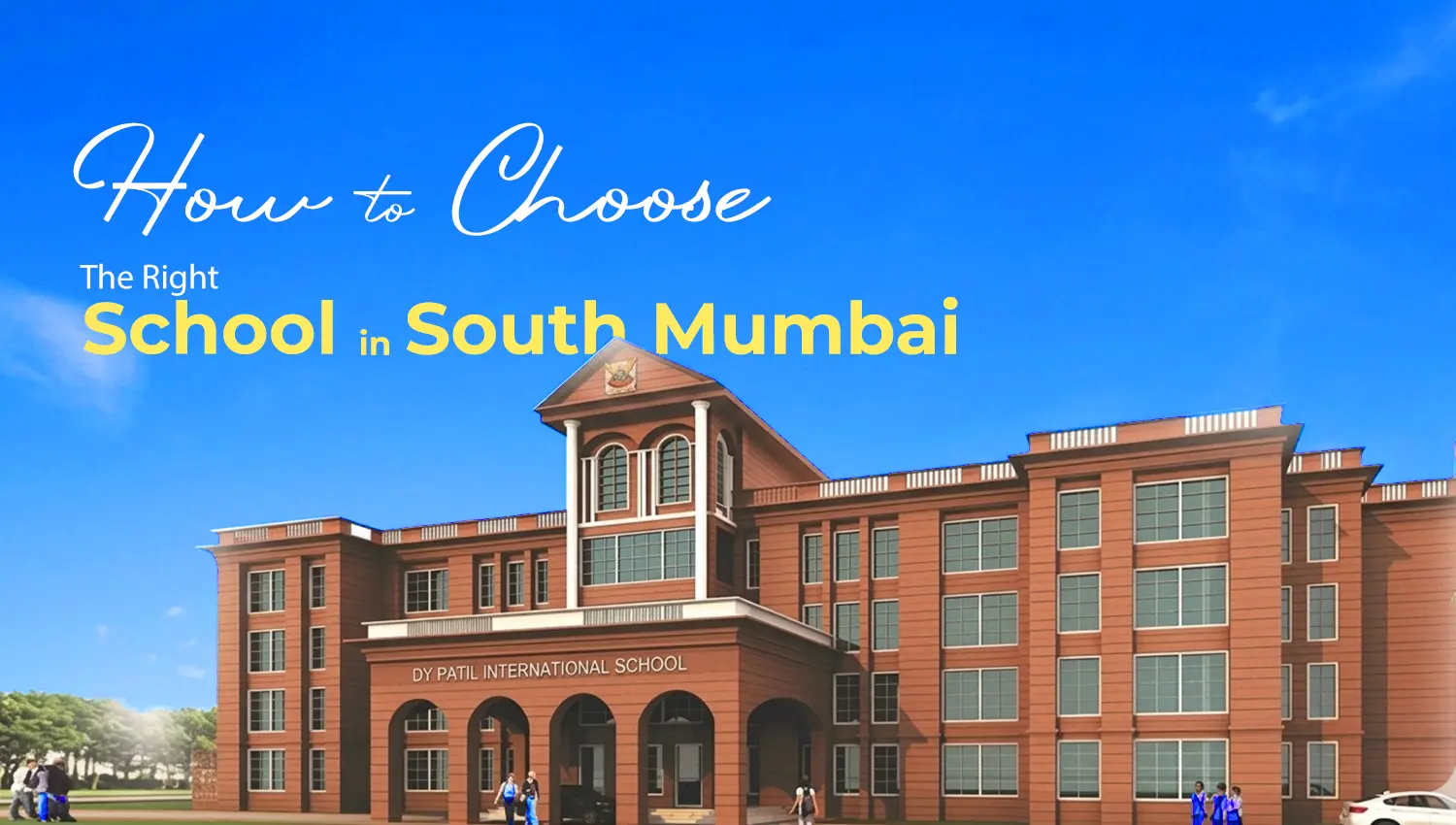
D Y Patil International School Worli offers IB PYP from Early Years to Grade 5, Cambridge Secondary Level 1 from Grades 6 to 8, Cambridge IGCSE in Grades 9 and 10 and a choice of IB Diploma, IB Career-related Programme or Cambridge AS and A Levels in Grades 11 and 12, making it one of the few schools in South Mumbai carrying a child through a complete internationally recognised educational journey within a single institution.
Frequently Asked Questions (FAQ’s)
Q1. What is the difference between CBSE, ICSE, Cambridge and IB?
Ans. CBSE and ICSE are Indian national boards. Cambridge and IB are internationally recognised frameworks accepted by universities globally. Cambridge assesses subjects through externally set examinations. IB frameworks emphasise inquiry-based learning and interdisciplinary thinking. They are different educational philosophies suited to different learners.
Q2. How much weight should rankings carry in the school decision?
Ans. Rankings narrow the shortlist. They don’t make the decision, because they compare schools across different curricula using metrics that may or may not be relevant to a specific family’s priorities. The ranking gets a family to a useful starting point. Curriculum fit and the visit make the actual choice.
Q3. What should parents focus on during a school visit?
Ans. How teachers respond to student errors in live classroom moments, what the school is genuinely proud of beyond examination results, how transitions between curriculum stages are managed and what class sizes look like specifically in the senior school years.
Q4. Is South Mumbai a good location for an international school education?
Ans. The cultural institutions, professional environment and civic life concentrated in South Mumbai give schools that use it deliberately a teaching resource that more removed locations can’t match at the same frequency or authenticity.