

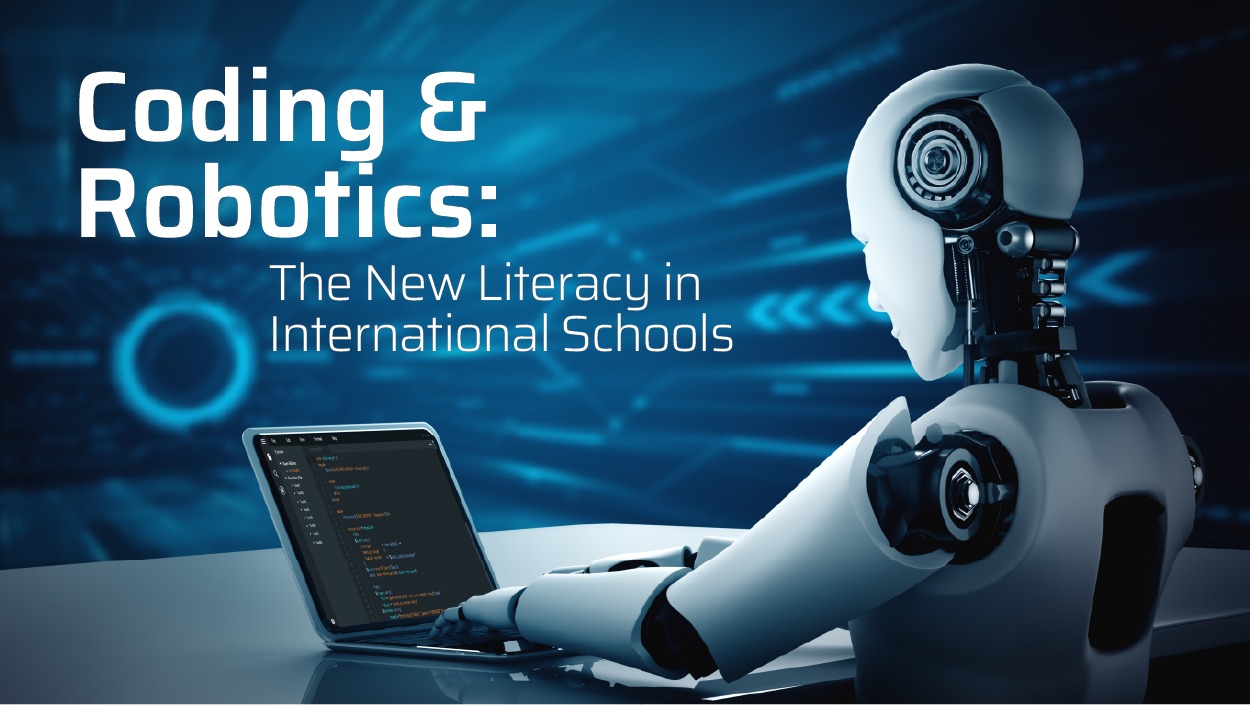
The meaning of literacy has evolved tremendously in the past decade. No longer are reading, writing, and arithmetic considered the cornerstones of elementary education to prepare students for the demands of the technology-driven world. Computational, algorithmic, automated systems thinking is now as essential as any other ability. In global schools, educators and policy-makers are beginning to understand that the new literacy—the one that will equip students with the cognitive capabilities to negotiate, contribute, and dominate the new century—will be coding and robotics.
Change to Technology-based Learning in International Classrooms
International schools have long boasted of a progressive, international curriculum. This has, over the last couple of years, meant a strategic and intentional integration of coding and robotics for kids into everyday learning. What was considered an extracurricular activity or elective subject has now been accorded its proper respect, and it is taught alongside the basic subjects. This kind of change does not happen haphazardly. The World Economic Forum has continued to promote computational thinking and digital fluency as among the most vital skills that will be used in the future. Places that respond to this reality stand a better chance of producing graduates, not merely technology consumers, but technology architects.
This change is particularly adapted to the international school environment with its extensive range of student populations and high academic standards. Getting students with diverse cultural and academic backgrounds to collaborate on the coding and robotics programs with children not only provides a technical level of skill development but also communication, collaboration, and problem-solving, which do not exist in any particular discipline.
Also Read – Top Private High Schools in Worli with Strong Academic Results
Computational Thinking and Its Role in Transforming the Manner in Which Students Learn
The ability to change the way of thinking is one of the most compelling arguments to think about incorporating coding and robotics for kids into schooling programs. Computational thinking is one transferable skill that can enhance performance across all subject areas and can be defined as the ability to convert complex problems into simpler steps that can be easily solved.
When a student is shown how to write a program, he or she must have a purpose, variables, anticipate errors, and repeat based on the outcomes. This is how the scientific method, logic in mathematics, and even literature reflect. In that matter, the use of coding and robotics does not substitute the traditional academic subjects; they simply complement them.
Also, students are particularly exposed to the physical component of computation through robotics. When a student programs a robot to do some task, he or she is able to see the immediate, physical result of his or her rational thought. Such a feedback loop is very inspirational, and the growth mentality—the understanding that failure is the bottom of success and not the bottom.
Age-Relevant Pathways: Availability of the Topic at Each Stage
The greatest myth is that coding and robotics are supposed to be taught to more intelligent or older students. Actually, well-designed programs lead to these concepts at every level of schooling, but the complexity is scaled to the cognitive development level.
At early years level, students learn with block-based coding environments and programmable toys, which teach sequencing and logical order through play. As students progress to middle school, they switch to text-based languages and more sophisticated robotics. By the time they reach secondary school, they are able to design, build, and program a complex system—at times it is even difficult to tell the difference between one of professional quality and one of secondary school.
This age development is what makes the coding and robotics for kids so effective. Rather than overwhelming young learners with abstract syntax, quality programs are designed in a manner that an understanding is built up step by step, so that students can gradually acquire real competence, but also real confidence.
Read More – Best Cambridge Schools Near Me with Good Extracurricular Activities
Final Thought: Future-Ready Education and DYPIS
D Y Patil International School Worli (DYPIS) is among the first to make such a change in education, and it is located in the heart of Mumbai. Because DYPIS is an international school and has a Cambridge affiliation, technology education is delivered in the holistic curriculum in a deliberate and rigorous way. This is evident in the manner in which the school has been making itself future-ready by investing in making its learners well-rounded individuals through its systematic approach to digital learning, where the learners are not only academically prosperous but also technologically intelligent.
This perception is reflected in DYPIS because education must mirror the world students are entering into. By incorporating the principles of computational thinking and technology-based learning into the everyday academic life, DYPIS prepares its students to be able to confidently, creatively, and purposefully lead in whatever they might choose to do in their lives.
Frequently Asked Questions
1. When should the kids be taught how to code and work with robots at DYPIS?
DYPIS introduces coding and robotics at a young age, featuring age-related learning experiences, which form technical confidence with the passage of time.
2. What is the place of coding and robotics under DYPIS?
DYPIS incorporates both coding and robotics into the curriculum, combining computational thinking with mathematics, science, and creative subjects throughout the Cambridge model.
3. Does it have any prior coding and robotics experience to enroll on DYPIS?
No previous experience. DYPIS ensures that it plans its technology programs in such a manner that it accommodates all learners and the basic concepts of the technology come first, and then upwards with the level of study.
4. What will students at DYPIS know about coding and robotics that will aid them in finding jobs in the future?
Through the provision of critical problem-solving and digital fluency skills, DYPIS will position students well to succeed in advanced education and work in an economy that is technologically oriented and globalized.